The Easy Button
I am sure somebody said it again last week, and it practically got a standing ovation. It always does.
“No pastor should ever ask you to be more dedicated to the church than to your family.”
The room exhaled. People nodded. A few mamas teared up a little. And listen to me, I’m not here to argue the point.
It’s true.
It’s also roughly as courageous as preaching against the flu.
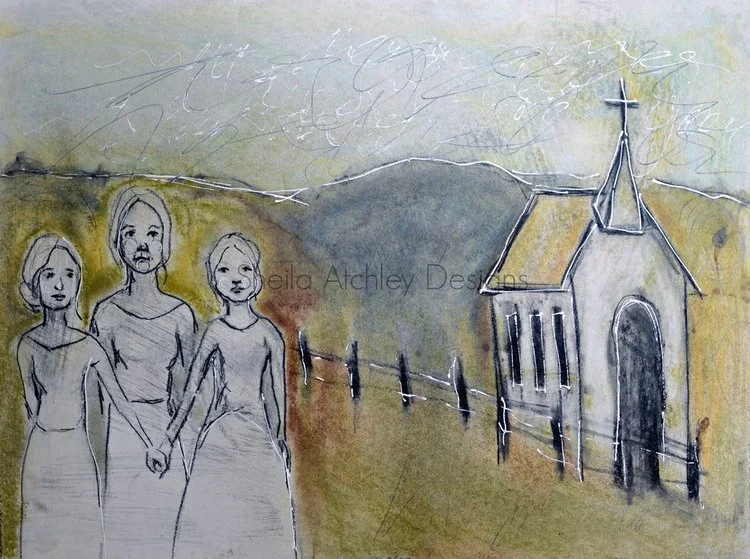
A (sold) painting titled “The Women of the Church”
What I want to talk about is what that kind of preaching costs the people, if that level of preaching is the vast majority of their spiritual nutrition.
Not what it costs the pastor, because it costs him exactly…nothing.
What it costs the people, in terms of the kind of vision that keeps them from perishing. Because the people of God were not assembled by God across the centuries, through exile and resurrection and reformation and revival, so that their shepherds could absolve them of all discomfort. They were assembled to do happy, hard things.
There’s a reason Habakkuk didn’t just hand the people a permission slip to go home and prioritize their families. My God, the prophet was pushing 70 years old at the time he preached his God-word…which in that day was…
…just as old as it is today.
He would have been smarter to have opted out of that message, for sure. I am certain that he wept. He wrestled. He climbed his watchtower and he waited and I imagine he argued with God and then…then…he came back down and he called the people to be strong.
And work.
He called them to a level of sacrifice that, at his age, he may not have been physically capable of doing an equal share of the labor.
His labor was to say the words. To call the people to be strong.
Not comfortable. Strong. The vision was for an appointed time. The righteous would live by faith. And faith, it turns out, is not a comfortable position. It is a set of working hands and a people who have decided to show up for the job.

Thing is, the work can be a glad work. We’ve been taught that honoring God usually looks like seriousness and pressure. But Julian of Norwich said this:
The greatest honor we can give God…is to live and work gladly.

“Julian of Norwich”, circa 2013
It is a false assumption to think that work must feel heavy to be real. What if gladness and wonder isn’t separate from the whole gift of work?
“Six days shall you labor and do all your work…”. (God)
To work as God’s beloved, is to work in a general state of gladness. Knowing there will also be the occasional “hard day”, but on the whole, we work with the grounding awareness that our work is sacred participation with God. (Interestingly, this post drops on May 1st, which is recognized as “International Workers Day”.)
Every church - I am telling you, every single one that has ever done anything worth doing, has seasons. Seasons where the fresh vision demands something more than even the level of sacrifice up to then.
Where the pastor, if he is doing his job, has to look his congregation in the eye and say: “This is a season, and maybe a long one. All hands on deck. We don’t have to do this, but we get to, and we will look back on it as the thing that made us.”
That is a dang-hard thing to preach. Which is why so few preach it.
It’s not hard thing for a pastor to offer his congregation what they already want to hear. To name the thing everyone already instinctively protects: their private lives, their weekends, their right to a reasonable ask, and simply bless it all from the pulpit. But is that shepherding real people for the real world, let alone equipping them for the work of the ministry?
The shepherd who truly cares about people is the one who can look at a season and name it for what it is. It is not a burden, it is not an imposition, and it is not a violation of their family time.
It is an invitation. A corporate moment. The kind of moment that ruins you for “Western churchianity” forever. A moment that bonds a people together the way nothing else will. Ask any woman who has ever painted a church nursery at midnight with three other women who became her closest friends (been there, done that).
Ask any family who skipped a vacation one summer because their presence was needed, and their kids watched them choose something bigger than themselves. (::cough::)
I can tell you something for sure: those kids grew up knowing what was being asked. And some of them maybe grew up resenting it…
…but some of them grew up to love the lifestyle and to be mighty in God. Ask me how I know. Nobody wants to talk about that (just as important) contingency.
And I am almost ashamed to use the above examples. Because we can always talk about the churches in Iran, Nigeria, and India, and what their pastors must equip them to be and to do.
A congregation shaped only by sweet preaching is a congregation that has never been asked to be anything together. They’ve been ministered to, encouraged, validated, protected from overreach, and they are, many of them, feeling purposeless - especially in midlife.
And the rate of attrition of those in midlife and “fourth quarter” in the church is staggering. It is affecting everything. Without a vision, the people perish slowly. But hey…there’s always Netflix.
You cannot manufacture the kind of belonging and sense of purpose that comes from sacrifice held in common. In all our efforts to properly preach the Gospel of Grace, we are missing the piece that speaks to the way we are wired: we must have a vision that lends purpose. The parent who loves their child tells them hard things. “You can do more than you think you can. This moment requires something of you. I believe you are capable of it.”
That is not harm. That is formation.
The prophet didn’t climb his watchtower to deliver good news about personal boundaries. He climbed it to see what God was doing, and then he called the people into it.
That’s the harder sermon. That’s the one that costs the preacher something. That’s also the one worth hearing.